Category Archives: Online Marketing

Contextual Commerce Change Shopping Experience

Contextual Commerce Change Shopping Experience

Contextual Commerce Change Shopping Experience


Contextual commerce combines the power of data from smartphones with the ease of interaction in physical spaces. 

Idea of “contextual commerce”  is, products that are delivered to a consumer as and when they are needed. 

Contextual commerce flips these current shopping paradigms on their head, turning the purchasing process into something that works in the customer’s favor — and not against them.

Contextual Commerce Change Shopping Experience, using data from devices like wearables, smartphones, and smart thermostats, the Internet of Things can help to streamline the shopping process. More importantly, it can ease the way we interact with products in physical spaces, not just in the online realm where it’s mostly been confined up until now.

The big issue with contextual commerce is that it treads a thin line between ultra-convenience and some potential breaches in privacy. 

The widespread effects of these changes in the digital world, their gradual move into our physical lives will drastically blur the lines between our online and real-life experiences.


WeChat a Must for Brands in China

WeChat a Must for Brands in China

WeChat a Must for Brands in China


Messaging app WeChat is something of a phenomenon. With around 600 million users, it is the largest standalone messaging app, and is currently ranked the fifth most popular mobile app in the world by Global Web Index, behind only Google Maps, G+, YouTube, and Facebook.

The strength of its reach and influence is such that brands looking to get a foothold in China seriously have to consider it within their mobile strategy for China, sometimes even leading with WeChat before they embark on their own applications, which have to be downloaded from an app store.

Native apps still play a role, but the decision to build one in China has to include a discussion around WeChat.

WeChat has an active, already enthusiastic audience – they are familiar with the structure, are happy to start a dialogue with other users.

Recent announcement of WeChat sponsored Ads, reaching an audience might be easier.

Like2Buy on Instagram

Like2Buy on Instagram

Like2Buy on Instagram


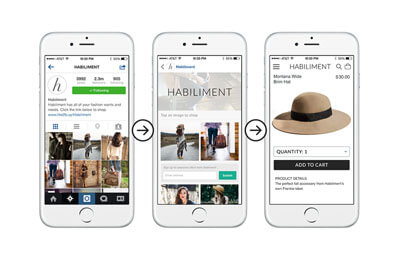
Curalate, a Philadelphia start-up specializing in visual marketing and analytics, has launched Like2Buy, a platform that makes it easier for people to shop on Instagram, as well as marketers to know what resonates with consumers.

Like2Buy places a link in a brand’s profile that when clicked, takes customers to a gallery identical to the company’s Instagram feed. 

“Some of the retail brands we work with could tell Instagram was driving revenue,” says Brendan Lowry, Curalate’s marketing director. “They’d post a product and see a slight increase in sales. But without a direct tie to Instagram, it was difficult for marketing to know exactly what was happening.”

Curalate’s main goal is to bridge this gap between Instagram and marketing, and allow marketers to gain true transparency into what is driving traffic and revenue. “They spent all this time and money to build the community but they’ve only been able to report on likes and follower growth,” Lowry comments.

Another goal, Lowry notes, is to make it as simple as possible for customers to get to the brands’ checkout pages – which they already trust, he points out – without them having to register for anything or even provide an email address.

Scott Houchin, managing principal of digital at knowledge process outsourcer eClerx, thinks Like2Buy shows the purchase power of Instagram’s younger audience.

“Their whole lives are consumed in these social ecosystems, so as they enter the workforce and start making money, we’re going to see a very accelerated curve of social commerce adoption,” he says.

Like2Buy isn’t the only platform to make Instagram shoppable, and others have attempted it in the past. 

Facebook Experiments Buy Button

Facebook-Experiments-Buy-Button

Facebook Experiments Buy Button


New feature will allow users to purchase items without ever leaving Facebook.

Facebook is trying out a “Buy” button that will let users make purchases from ads and companies’ Pages, all without leaving Facebook’s platform. Customers also have the option to store their payment information, which eliminates two big conversion hurdles: getting a customer to the checkout screen and having them enter their credit card number.

 Facebook says the Buy button is as secure as possible.

But while some people might think the feature allows businesses to intrude on their social community.

And this isn’t Facebook’s first foray into the e-commerce sector. Two years ago, the platform launched Collections. 


Pinterest Highlights Products for Sale in Gifts Feed

Pinterest has created a Gifts feed to showcase the items on the network that are for sale, the visual discovery tool revealed on its official Pinterest business blog

Pinterest Highlights Products for Sale in Gifts Feed


The new feed showcases only Product Pins, or Rich Pins with information about pricing and availability

Pinterest has created a Gifts feed to showcase the items on the network that are for sale, the visual discovery tool revealed on its official Pinterest business blog.

The Gifts feed, which the post describes as a “work-in-progress feed,” displays only Product Pins, which are Rich Pins that include additional details like real-time pricing, availability, and where they can be purchased. With Product Pins, pinners also receive email notifications when pins they’ve added drop in price.

Product Pins help pinners “decide which products are right for them,” the post says.

The Gifts feed also includes price filters designated by dollar signs “so you can find something for every budget,” Pinterest says.

According to the post, $$$$ represents products that cost more than $200, $$$ shows products between $50 and $200, $$ is for products from $25 to $50, and $ “is anything less than that.”

“So far, we’ve learned that Product Pins get higher click-through rates than regular Pins and make your brand more visible because of the logo on the Pin,” the post says.

Product Pins also include tabs that pinners can click to see the products on the e-commerce sites where they can be purchased.

Pinterest says it launched the Gifts feed because “we know people love to use Pinterest for shopping ideas.”

The Gifts feed lives within Pinterest’s regular categories.

Ways Your Brand Can Stand Out on Twitter

Ways Your Brand Can Stand Out on Twitter


Keeping an eye on what others are doing on the channel is an excellent way to learn the latest strategies and tactics.

With more than 241 million active users on Twitter, more and more brands are realizing that establishing a presence there is no longer an option. It’s a must.

Success on Twitter takes time as well as a deep knowledge of the best practices that only comes with experience through trial and error.

To monitor how brands are using Twitter to capture the attention of their constituents.

Newsjack What’s Hot.

Taking advantage of trending news by writing about it as it is breaking can be a very effective way to inject your brand into the conversation. During this year’s Super Bowl, many brands were playing the newsjacking game, sharing their quips in real time.

Ask Questions. 

Any networker worth. Ask them anything. The more you ask them questions, the more likely they’ll be to trust that you’re genuinely interested in their needs and interests, more likely they’ll be to do business with you when the time comes.

Engage With Other Brands.

 Back in the day, it would have been highly unusual – and nearly impossible – for one brand to talk to another. What would be the point? And without the Internet, there wasn’t really a good forum for such conversation, anyway. Social media changes everything. And today, now that most brands have the basics of Twitter down, they’re going where no brands have gone before, reaching out to one another for not just casual banter, but for strategically timed engagement.

Embrace Your Fans.

People follow brands on Twitter for a number of reasons, one of which is for a digital autograph, a chance to connect with someone or something they adore. One-on-one interaction is ideal. 

Talk About the Weather.

 What’s the one thing people talk about when they have nothing else to say? The weather! Everyone is interested in the forecast, the temperature, and whether it’s sunny, raining, or snowing outside.

Be Responsive.

Is a  fact that more than 70 percent of users expect brands to get back to them on Twitter in less than an hour

Sense of Humor. 

Far too many brands take themselves too seriously on Twitter. For them, every single tweet is watered down, devoid of any personality whatsoever, never mind a sense of humor.

Give Away. 

Perhaps the easiest way to stand out among the competition for attention on Twitter is to host a contest or sweepstakes.

Inspirational. 

Whether you’re marketing to businesses or consumers, don’t forget that you’re talking to other humans on Twitter.

Share Knowledge.

Speaking of being helpful, some of the most popular accounts on Twitter are those that provide insight and information to their followers. 

Rules for Better Social Branding

Rules for Better Social Branding Prime Promo Online Advertising Company

Rules for Better Social Branding


There is no one universal approach to building and maintaining a good brand. These are constant marketing truths and tactics one should keep in mind:

Be Specific

Some branding campaigns try so hard to be different they lose their relevance or the message requires too much explanation. Remember: different is not always good, especially in the online and mobile environments when you have just a few seconds to capture someone’s attention and connect with their emotions.

Be Helpful

Ask yourself this question: “Why would anyone want to hear from us?” Make sure there is a reason to connect to you.

Give people a reason to connect with you and make them one of the driving forces of your social content and promotions. “Check us out on Facebook” really is not a great call to action. If your targeting B2B, maybe it’s,  “Get industry insight success tips – Follow us on Twitter.”

Make People Talking 

Remember, in social your brand is not what you say; rather, it’s what people say about you.

Spark conversation and promote content that generates dialogue between the members of your community and even their friends. Encourage interactions, ie.: “Ask your friends” This will also boost your “Talking about this” on Facebook.

Be Human

Social media is the right place to show the human side of your company. Let people get to know not just your products, but the people behind your products. Remember, social media is about socializing and people want to feel like they are connecting with real people who share their values and emotions.

It is impossible to communicate with an inanimate object. Loosen up a little bit and show the face behind the curtain. Really be friends with the lovers of your brand!

Encourage the share

The share is as valuable as the Like or Follow! It creates peer to peer impressions featuring your brand.

Make content that is worth sharing and then make the share the call to action you are trying to encourage. We all want engagements, conversions and actions – but what about shares? Remember – the share is the action.

Ways to Link Social and SEO

Ways to Link Social and SEO

Companies expend amazing amounts of time and resources on social media marketing. But it’s clear to me that one simple fact is constantly lacking in their strategies and tactics – SEO. That fact is that success in social, especially for B2B companies, is very often realized through search. 

Tips how you use all those target terms, links, and hashtags in your social media marketing.

Choose your target terms much as you would do with SEO.

You can hardly expect your social media managers to optimize your content with high-value keywords if they don’t even know what those keywords are. The list needs to be relatively short – unless you’re an e-commerce site with literally thousands of products, focus on the top 50 to 100 most popular and relevant terms. If your list is too long you will be watering down the effectiveness of your SEO program by spreading yourself too thin.

Google’s keyword selection tool is a great resource for this and it’s free.

Choose target pages on your site that have good content and may be already ranking on the first couple pages of Google and match those pages to the keywords you want them to appear under. Keep in mind that not all pages will map neatly to one of your target terms. In many cases you may be matching target terms with your home page, services pages, or other general pages. When you use the term try to link to that page and use the term as the anchor or link text.

Identify all the hashtags being used around relevant conversations on Twitter.

Sure, it’s good to make up your own hashtags. However, it can often be better to utilize existing hashtags to access the conversations your prospects and customers are already having.

Create a worksheet with a list of target terms, Twitter hashtags, and the URLs you should be trying to link to when you use those target terms in social content. Now here’s the key thing: they should be using this list and worksheet in an opportunistic way. In other words, they don’t have to be playing a Boggle word game trying to figure out how to use these terms and links. They should be using them when it makes sense from a contextual and grammatical standpoint. 

Use your target terms, hashtags, and links opportunistically in your tweets. Also remember that people don’t just see the tweets from the people and companies they’re following. They also search in Twitter using specific keywords.Tweets do get indexed in Google!

Facebook posts

Use target terms and links in your Facebook posts, if you have a public fan page. Google is indexing your posts and they are showing up in search results.

Use your target terms and links in your LinkedIn and posts. 

Use your target terms and links in your blog titles and copy. It’s especially important to utilize your links in the first few sentences of your blog post since other bloggers who subscribe to your RSS feeds and republish your posts often abridge and truncate them and then link back to your blog post.

Use your target terms and links in the press releases you drop on the wire services. As with your blog posts, utilize your links in the first two sentences since sites and bloggers that republish press releases often abridge and truncate them and link back to the wire services version of the press release.

Use your target terms and links in all of your content posting descriptions. This includes your Facebook about profile, video titles and descriptions in YouTube, presentation titles and descriptions in SlideShare, image titles and descriptions in Flickr and Pinterest, PDF postings, and Docstoc.

Make sure that all the valuable content on your site including images, charts, graphs, white papers, and videos are socially enabled. What do I mean by that? I mean that you have big noisy share buttons that encourage people to post your content to their social sites.

Make sure to configure your share copy so it utilizes high-value keywords. Don’t let the share buttons automatically grab images and copy from your page. Tell your web developers that you want to control what the share copy says when someone hits the share button on your site.

Tell bloggers it’s OK to grab your images, charts, graphs, and other content as long as they link back to your site. In fact, encourage them to do so.


 

4 Important Online Advertising Opportunities

4-Important-Online-Advertising-Opportunities-primepromo.eu-Online-Advertising-Prime-Promo-Online-Advertising

4 Important Online Advertising Opportunities

It’s time to get serious about moving marketing strategies to social and mobile.

A few major themes are emerging that digital marketers and their media teams must plan .

Facebook is changing

Now that Facebook is through the turmoil of its IPO and can get back to work. Focused on more targeting, analysts predict Facebook advertising will grow by bounds in this year. CPMs are low, new formats are incredibly effective.

Mobile

Mobile advertising has been dominated by search (Google), display (ad networks), and a few rich media options like iAds. Facebook has taken the lead in mobile display, almost overnight. Facebook shared that its mobile ads, which are primarily promoted posts in the mobile newsfeed, are 42 percent more effective than its standard display ads, and the performance increases when richer post types like photo, video, and interactive are used.

Rich media

Rich media ads on traditional websites are well-established. But as consumers increasingly move toward social and mobile – and away from websites – we’re seeing ad technology shift as well.

We all felt it in 2012: social streams, from Facebook and Twitter to Pinterest and Instagram, became richer and richer. More photos, more video, more interaction, all right there in the streams. This trend, will continue in this Year.

Video

Much of the growth in digital media in this year will be because of the expanding video opportunity. Social and mobile are fertile ground for video, but we’ll also see innovation from YouTube and Vimeo.

This site uses cookies to offer you a better browsing experience. By browsing this website, you agree to our use of cookies.